
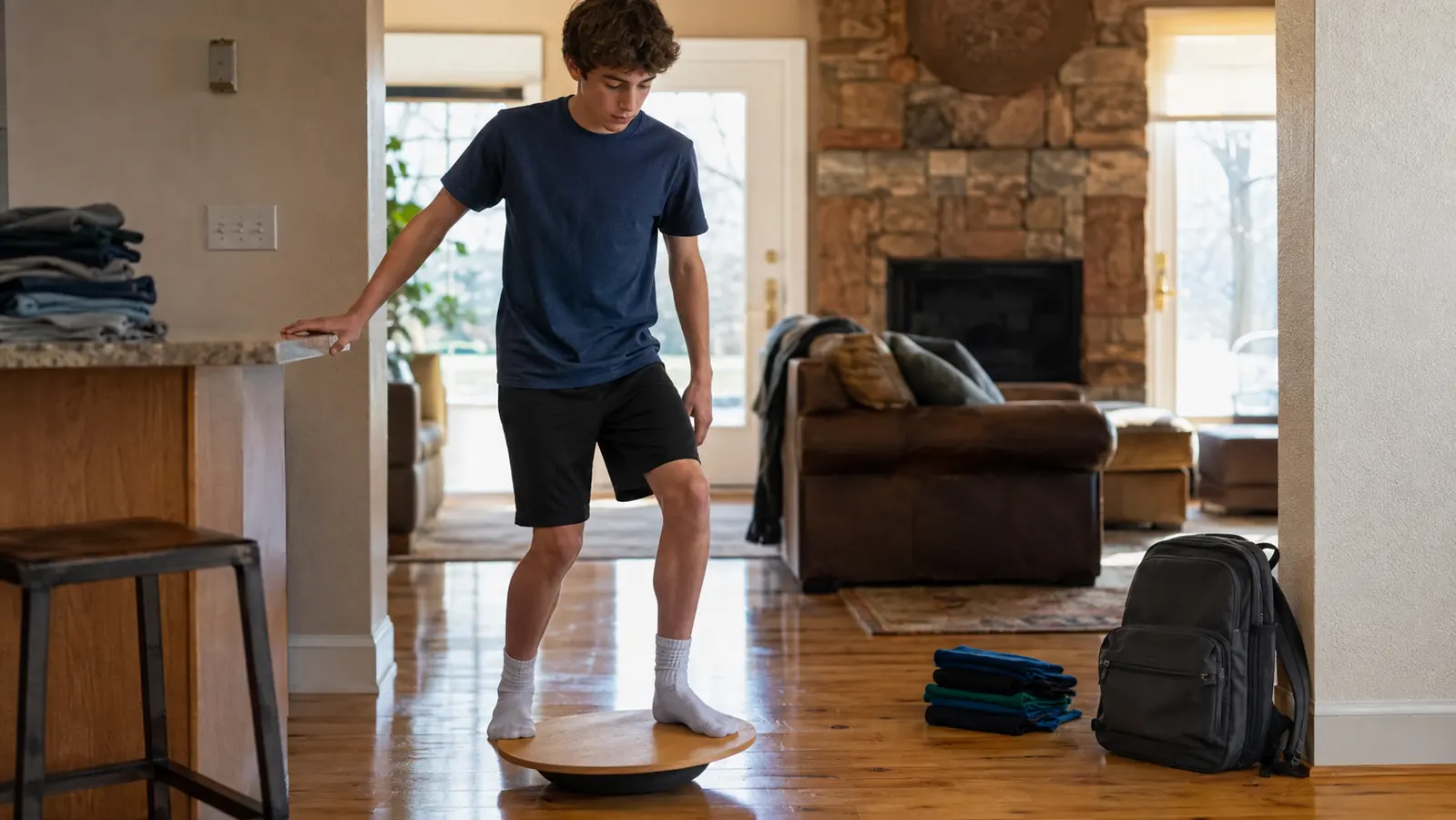
Theo rolled the same ankle twice in one wrestling season, once during a scramble in December and once at practice in February, and both times the trainer's first question afterward was the same, has anybody been doing single leg balance work between matches. Neither time was the answer yes, not really. We had a lot of good intentions and a folded yoga mat in the garage that nobody used for that. After the second roll, Mari's club trainer mentioned the same kind of board she has her setters standing on during down time between sets, for ankle stability, not for building anything. I finally went looking for one instead of nodding along again, and that is how a StrongTek wooden wobble board ended up living on our living room floor for the better part of eight months.
I want to be straight about what I was and was not trying to fix. This was never meant to be a workout, and it still is not one. It is a few minutes of standing on an unstable wood surface, meant to wake up the small stabilizer muscles around an ankle or a knee, the kind of thing Mari's trainer calls boring but real work. I am not a physical therapist, an athletic trainer, or any kind of clinician, and nothing in this review is medical advice or a promise that standing on a board keeps an ankle from rolling again. What I can actually tell you is what eight months of this board living in our house looked like, who kept using it, who quietly stopped, and what the wood and that grip surface did over that stretch.
The Quick Verdict
A genuinely simple piece of wood that earned a permanent spot by the kitchen counter, not because it fixed anything by itself, but because it kept getting used.
Amazon Check Today's Price →The between-matches habit that actually stuck for eight months
Most gear we buy for the kids' sports gets used for three weeks and then forgotten in a closet. This board is still standing by the counter in month eight. See the StrongTek board and current availability on Amazon.
Amazon Check Today's Price on Amazon →How We've Actually Used It
This is one family's eight months, not a lab study, and I want that said plainly up front. The StrongTek board showed up in our house right after Theo's second ankle roll, and it has lived in the same spot since, on the hardwood by the kitchen counter, where anyone can step onto it for a few minutes without moving furniture. Theo uses it most, usually after wrestling practice, standing on it while he half watches whatever is on the kitchen TV, one hand resting on the counter edge out of habit more than actual need most nights.
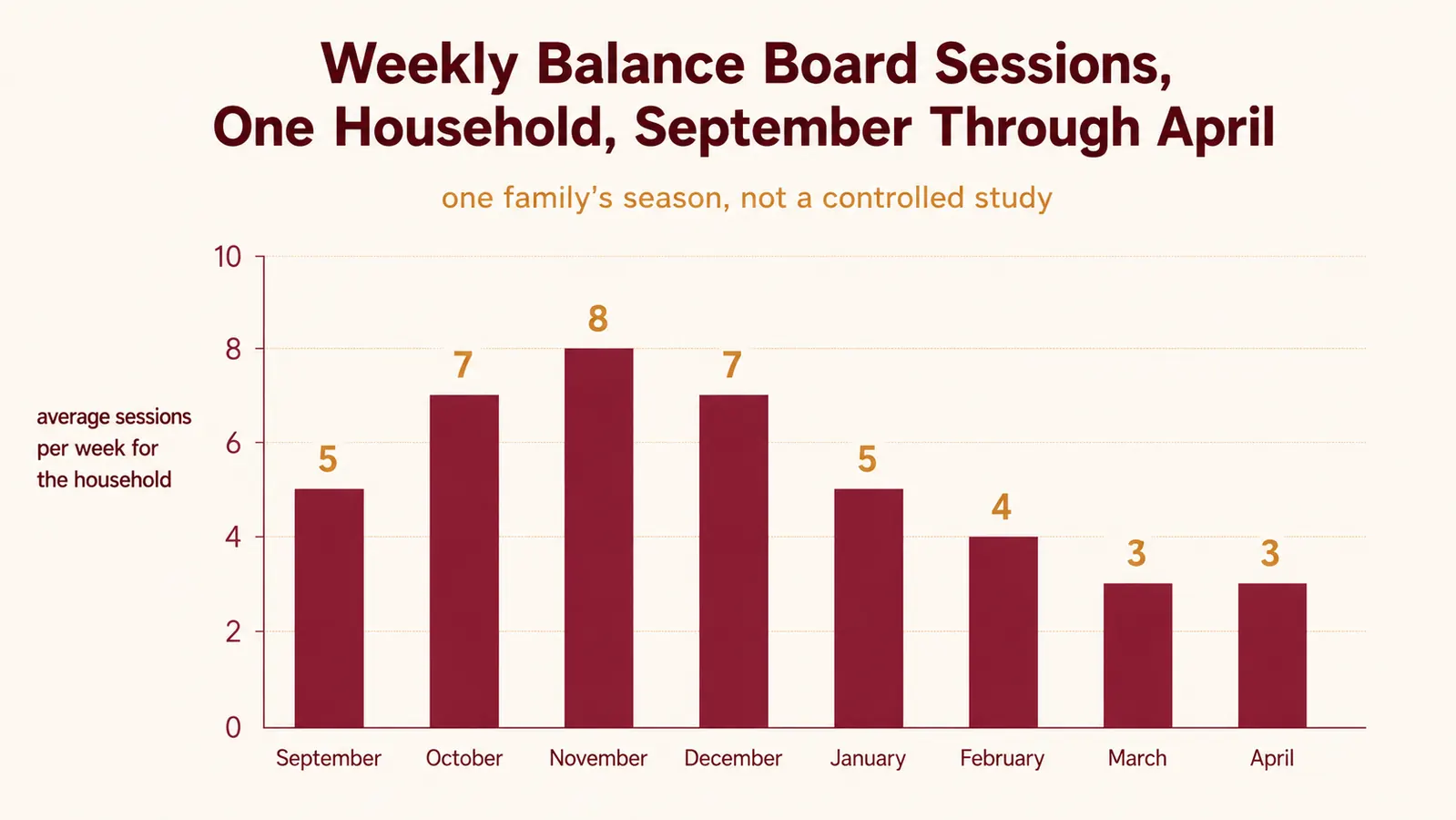
Mari used it heavily for the first two months, mostly on the basic rocker setting before Saturday tournaments, since her trainer's whole pitch was ankle and foot stability for a setter who is up on her toes constantly. I use it too, on my worse hip days, a few slow minutes finding my balance before I head out to haul chairs and coolers, which is not a fix for a hip that started aching around 49, but it is something. Danny has tried it exactly twice, both times joking about his balance and both times declining a third attempt, and that is honestly a fair summary of how this board sorted itself out across our house.
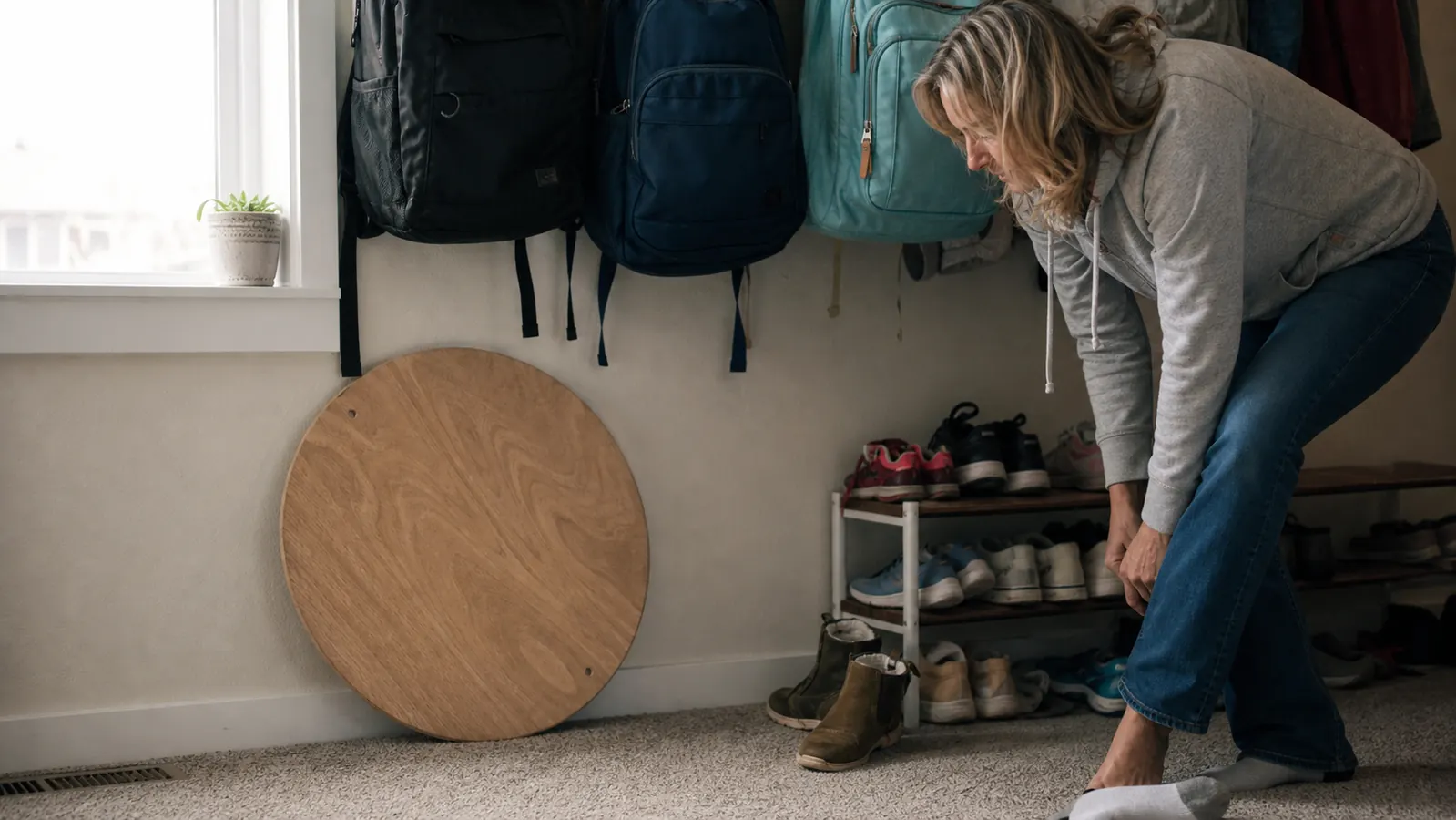
Storage is part of why it survived, and I do not think that is a small thing. The StrongTek board is round, not much bigger across than a large mixing bowl, and light enough that Theo can pick it up with one hand and set it against the wall without thinking about it. Compare that to the resistance bands or the foam roller that both live in a drawer because putting them away properly takes an extra step nobody wants to do at nine at night after practice. This just leans. That is the whole system, and it is probably the single biggest reason it did not end up forgotten in the garage with the rest of Danny's equipment.
The Two Modes, and Who Actually Used Which
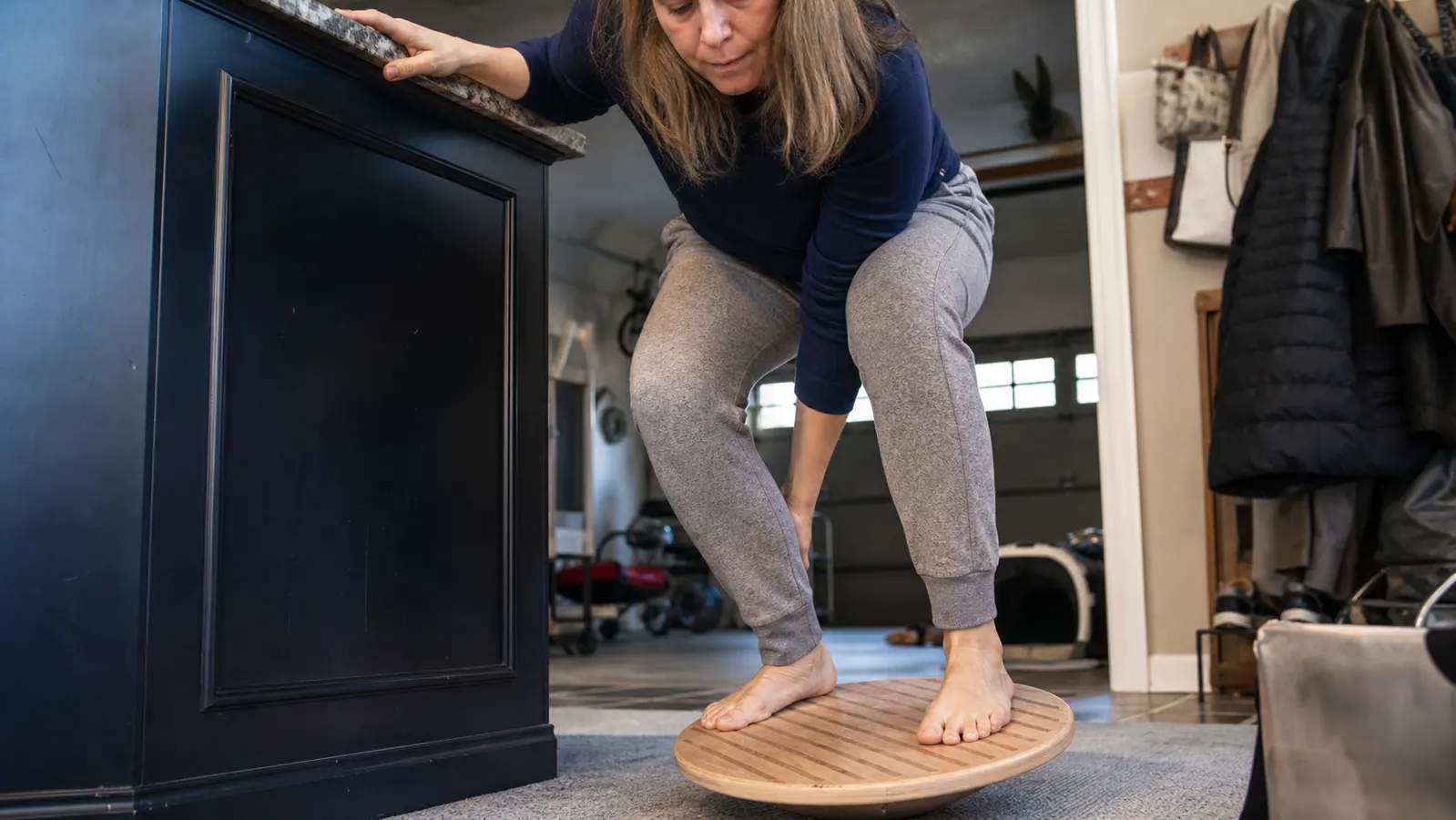
The StrongTek board flips between two setups, and that turned out to matter more than I expected when I first pulled it out of the box. Flip the base one way and it rocks on a single axis, front to back or side to side depending on how you set it down, which is the gentler basic rocker mode. Flip it the other way and the base becomes a rounded dome that lets the board tip in any direction at once, the advanced 360 wobble mode, and it is a genuinely different challenge, not a small step up.
Theo went straight to the 360 mode within the first couple weeks and has stayed there since, since that is closer to the unpredictable footing a wrestling scramble actually demands. Mari stayed almost entirely on the basic rocker, which made sense for what her trainer was actually after, controlled front to back stability rather than the harder all direction balance work. I have never once tried the 360 setting and do not plan to. The rocker mode is plenty for a few minutes near the counter on a bad hip day, and I have no interest in adding a fall risk to my own routine.
What Eight Months on a Hardwood Floor Actually Did to It
The wood itself has held up better than I expected from something that gets stood on daily by a 14 year old wrestler who does not always land his feet gently. There is a shallow scuff pattern worn into the finish where Theo's feet land most often in the 360 mode, visible if you look for it in good light, but nothing that has splintered, cracked, or loosened at any seam. The rounded base pieces that let it rock or wobble still move the way they did in week one, no wobble in the wrong direction, no play where the two halves meet.
The non slip top surface is the part I watch closest, since that grip is the whole reason this is safe to use in socks near a hardwood floor. Eight months in, it still grips the way it did the first week. It has not gone smooth or glossy the way a cheap rubber mat sometimes does with heavy use. The one real complaint, and it is a small one, is noise. A 14 year old wrestling on the 360 setting on hardwood produces a rhythmic thump that carries through the house, and more than once I have hollered from the kitchen to take it to the rug in the family room instead.
Whether It Stayed in the Living Room or Ended Up in the Closet
This is the honest answer to the question I would ask if I were reading this instead of writing it. The StrongTek board never made it to the closet, but it also never stayed the shared family fixture I pictured it being in month one. By month three, Mari's tournament schedule got heavier and her own warm up routine, which we cover separately, took over the ten minutes she used to spend on the board. She still steps on it occasionally before an especially long Saturday, but it is no longer a regular habit for her the way it was that first fall.
For Theo it went the other direction. What started as something the trainer suggested after an injury turned into a genuine after practice habit that has outlasted the wrestling season itself, since he still uses it on off days heading into spring conditioning. The board sits leaning against the wall by the shoe rack near our front door now, not tucked into a closet, mostly because that spot is close enough to the kitchen counter that stepping onto it takes zero extra effort. Gear that survives in this house tends to be gear that asks nothing of anybody, and this one mostly does not.
The One Safety Habit We Never Skipped
I will say this plainly because I think it matters more than any wear and tear detail. Nobody in this house started on the 360 wobble mode cold, and nobody uses this board barefoot on a slick floor without something solid within reach. Ours lives right by a kitchen counter for exactly that reason, and the first several sessions for both kids were spent with a hand on that counter the entire time, only letting go once balance actually felt steady. That is just common sense with anything that intentionally makes the floor unpredictable under your feet, and it is worth saying since a board like this can genuinely put someone on the ground if they treat it casually on day one.
I also want to be clear about what this board is not, since Mari's trainer was careful about the same thing when she first mentioned it. It is a tool for stability work, not a treatment plan, and it is not something either of my kids uses as a substitute for actually resting an injury or seeing someone qualified about it. When Theo's ankle was freshly rolled, this board sat untouched for over a week while he iced it and we watched how it healed, and it only came back into his routine once that swelling was fully gone. Anybody working through an actual injury should be following a trainer's or a doctor's plan, not an article, and this board is meant to sit alongside that kind of guidance, not replace it.
I also think about what this cost us in a different way than dollars, which is effort. A board that leans against a wall and takes zero setup beats a workout plan on paper every single time in this house, no matter how good that plan looks on the page. That is not a knock on real training programs, it is just an honest account of what a family running three schedules at once actually has room for. If a piece of gear needs a calendar reminder to get used, it loses to something like this within a month, and we have the unused equipment in the garage to prove it.
What I Liked
- Wood construction shows only light cosmetic wear after eight months of near daily use
- Non slip grip surface still grips like new, no smoothing or gloss even with heavy use
- Flipping between basic rocker and advanced 360 wobble modes still works exactly like week one
- Small enough footprint that it stays in easy daily reach instead of getting stored away
- Genuinely different balance challenge between the two modes, not a token setting change
Where It Falls Short
- The 360 wobble mode is loud on hardwood floors, needs a rug or gets banished to another room
- Mari's use tapered off hard once her own warm up routine took priority
- No cushioned bumper on the base, so it can nick a hardwood floor if it tips over hard
- Does nothing on its own, it only works if somebody actually steps on it consistently
It never promised to keep Theo's ankle from rolling again. It just gave him something to actually do about it besides worry.
Who This Is For
This is for a family with kids in the kind of sports where footing matters, wrestling, volleyball, soccer, anything with quick direction changes, especially if a trainer has already brought up ankle or knee stability work the way Mari's did. It also works for a parent like me who just wants a few minutes of balance practice on a bad hip day, without turning it into a workout. If your house already has a spot near a counter or a wall where a board like this can live in plain sight, that alone makes it far more likely to actually get used than something that has to be dragged out of a closet every time. We cover ten more specific reasons a board like this earns its spot in a family's routine in our other piece on that exact question, and if you want the shorter, more skeptical version of this same review, we wrote a separate honest take on what nobody tells you about a board like this too.
Who Should Skip It
Skip this if you are picturing a strength trainer or a workout program, because that is not what it is and it never became one in our house, no matter how many times Danny eyed it that way. Skip it too if anyone in your house is currently working through an active ankle or knee injury without a trainer's or doctor's plan already in place, since balance work like this belongs alongside real guidance, not in place of it. And if your family's schedule genuinely does not have a spot where this can sit in daily reach, be honest with yourself about whether it will get used at all. Ours only survived because it never had to be found first.
Still by the counter after eight months, still getting stepped on
A season and a half of daily use on a hardwood floor is a real test for a piece of wood. This one passed it. See current availability and pricing for the StrongTek balance board on Amazon.
Amazon Check Today's Price on Amazon →